
Ovarian Cyst Rupture Discharge (Brown, Clear fluid, White): What’s Normal?

Last updated on July 27th, 2018 at 12:51 am
Question: Ovarian cyst rupture discharge – brown, clear or white, what’s normal and what’s not?
Between the age of 15 and 50 years when a lot of women are able to conceive, some challenges may occur.
First, vaginal infections are very common and may result from an unprotected sexual intercourse.
Secondly, women at this phase of life are also more prone to have uterine fibroids, as more than 60 – 70 percent of women will have a fibroid.
Another reason to worry during your reproductive years is an ovarian cyst.
How does an ovarian cyst occur?
Between 2 of your period, your body undergoes changes that result in the release of an egg from your ovaries. This is called ovulation and mainly occurs because of the effect of hormones.
Before ovulation, estrogen is particularly dominant and causes plenty of follicle in your ovaries to develop. As these follicles develop, only one grows very big and contains the egg to be expelled.
During ovulation, this “very big follicle” now breaks open and pushes the egg toward the fallopian tube.
Subsequently, after the release of the egg, the follicle forms the corpus luteum that aid the development of the endometrium by secreting progesterone and estrogen.
An ovarian cyst will occur when an ovarian follicle fails to break open and rather accumulates fluid making a cyst (follicular cyst). Also, an ovarian cyst may form if the corpus luteum fails to be absorbed and rather forms a cyst (corpus luteum cyst).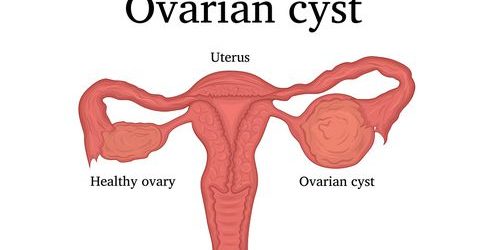
It’s possible that women may have a cyst that contains different kind of tissues – hairs, bone, and sometimes cartilage. This is known as a dermoid cyst. Another type of cyst is the endometrioma cyst that usually contains dark blood.
Depending on the kind of cyst, you may experience different symptoms. Most women that have a cyst will not even show any symptoms as within 1 – 3 month cyst will resolve without any treatment.
Nevertheless, some women may be unlucky when a cyst ruptures and releases its content into the abdomen. This may result in severe pain and may sometimes be a surgical emergency.
This article explains the symptoms of an ovarian cyst, signs of a ruptured ovarian cyst, and what an ovarian cyst rupture discharge color means – brown, black, white and clear.
What are the symptoms of an ovarian cyst?
An ovarian cyst in most women will not show any symptoms at all. In fact, in some women, cyst on the ovary is detected after an ultrasound scan for some other medical reason.
Here’s an email I received from Emily
H Doc,
I have been trying to get pregnant for about 6 years after getting married. But its be unsuccessful. I was recently asked for an ultrasound scan for my doctor which reveals i have multiple cyst on my ovaries. Is this normal? Could it be the reason am yet to conceive?
Just like Emily, a lot of women will have a cyst and never even get to feel any symptoms. However, some women will be symptomatic and usually experience any of these signs
- Pain in one side of the abdomen
- Pain while having sexual intercourse
- Vomiting
- Nausea
- Difficulty conceiving
- Irregular menstrual cycle
- Abdominal distention and bloating
- Severe abdominal pain after exercise
What are the symptoms of a ruptured ovarian cyst?

If you’ve been diagnosed with an ovarian cyst, there is a tendency that your cyst may grow big or burst open into your abdomen releasing its content. This usually occurs after sexual intercourse or a vigorous exercise.
Symptoms of a ruptured ovarian cyst are
- Sharp pain on the lower, right or left side of your abdomen
- Dizziness
- Fast heart rate
- light-headedness
- Fast breathing
- Fever
If a cyst that contains clear fluid ruptures, within a few days, your body absorbs its content and does not usually require further treatment.
On the other hand, a dermoid cyst that contains different particles (hair, bones, and cartilages) or a hemorrhagic cyst (that contain blood) will result to sharp tummy pain that may require surgery from your doctor.
One other reason to worry is a large ovarian cyst that pulls your ovary and “twists it” thereby obstructing blood flow to your ovaries resulting in a sharp belly pain.
If you’ve been diagnosed with a cyst, any sudden sharp pain should be communicated to your health care provider.
What causes ovarian cyst rupture discharge?
Ovarian cyst usually will go unnoticed a lot of times. However, if they rupture, you will experience pain in your abdomen and sometimes a new type of discharge.
Your ovaries are connected to your uterus and vagina through the fallopian tubes. If a cyst rupture, fluid flows through your fallopian tubes into the uterus and may be seen as discharge.
Depending on the content of the ruptured cyst, the volume and color of our discharge may change.
What does ruptured ovarian cyst brown discharge mean?
Here’s another email I received from one of my readers
I need help as i feel something bad is happening. Last week i had severe pain in my belly and quickly informed my doctor about my problem. Turns out that i had an ovarian cyst rupture.
I was admitted for about 24 hours and asked to go home. But now, i see bloody discharge that sometime may be yellow. Is this normal or should i see my doctor again?
If you’ve had an ovarian rupture, it’s possible you may experience a brown discharge; Though there are many other reasons for brown spotting listed here.
This will occur in women that have had an endometriosis cyst, where tissue that usually covers the inner lining of the uterus and displaced to the ovaries and forms a cyst. Commonly, they are referred to as “Chocolate cyst”.
A chocolate cyst may vary in size and may be small or large and usually contains dark blood. This black colored blood, after the rupture of the cyst, will mix with your vaginal discharge and form a black, dark or brownish looking discharge.
What does ruptured ovarian cyst clear whitish discharge or fluid mean?
Most commonly, it’s possible you could have a cyst rupture without blood leaking into your abdomen.
If you have a ruptured cyst without any bleeding (clear fluid), you will experience a clear and white discharge. Also, depending on the size of the cyst, vaginal discharge may be much more than normal and excessive for a few days.
Worried about the color or volume of your discharge after a ruptured ovarian cyst? Let us know.

Jessi McElroy
I have had my tubes tied for 3 yrs and befor children i got ovarian cyst all the time. Now my question is how can I have The clear /white discharge if my tubes are tied and the cyst in on my ovary?
Imelda Oliden
I have the same issue and my tu es were also tied 3 yrs ago. Just had a cyst rupture this week no longer in as much pain but comes and goes. And still bloated.
Jacqueline
I am having brown discharge from my cyst is that good or bad. In the beginning it was red but only a little and now it is brown. Does that mean it is healing. Also, I am not experiencing any pain I’m just having brown discharge and there is a smell in my private area.
Danielle
Hi Jacqueline,
I’m having the same problem, did you ever find out the discharge was from your cyst?