
Vulva Itching Worst at Night (Private Part): Causes, Treatment

Last updated on July 26th, 2018 at 04:36 pm
Question: Why is vulva itching worst at night? Are there home remedies for itching of the private part?
For most women, itching of any part of the body, especially the private area, is due to an infection. If you have itching down there and you are worried, you shouldn’t.
First of all, vulvar itching is not a serious medical issue, and it is possible that you do not have an infection. Women who use different products (detergents, creams, vaginal douching, perfumes, scented soaps) on their private part may irritate the vagina and cause itching.
Vaginal itching due to irritation of the vulva can easily be prevented. This means you have to be proactive and entirely avoid these products that make you feel uncomfortable down there.
Having said that, vulvar itching may be due to an underlying medical issue, and in some cases, you will need to see your doctor for urgent help.
Serious causes of vulvar itching are yeast infection, sexually transmitted diseases, bacterial vaginosis, advanced age more than 40 – 50 year, stress, and vulva cancer.
Vaginal yeast infection is one of the common culprits why you feel an uncontrollable itching sensation at your private area. It is caused by excessive growth of fungi at your vagina and affects about 75 percent of women.
While yeast infection may readily be treated with over the counter medications, vaginal itching may be due to other serious health issues. Therefore, its best to see your doctor.
What to expect from your doctor?
While planning to inform your doctor of your itching, you must be ready to answer his questions. Here are some questions you will be asked.
- When did you notice vaginal itching?
- Is there any change in the color of your vaginal discharge?
- Do you use irritant like perfumes, sprays or wash your vagina with a douche?
- Do you have multiple sexual partners?
- Is there any change to the surrounding vaginal skin?
- Do you have pain in your lower abdomen?
- Any fever, body weakness, vomiting, and back pain?
- Do you feel pain while urinating?
This article explains causes of vulva itching, home remedies, and prevention tips.
What causes vulva itching worst at night?
If you are experiencing mild, moderate or severe itching of your vulva area, here are the main reason its happening.
1. Yeast infection
Yeast infection is caused by fungi called Candida albicans and naturally cohabits with other organisms in your vagina. If there is any change in vaginal balance and overgrowth of fungi, it causes a yeast infection
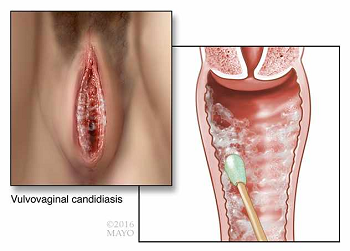 Fungi overgrowth can happen after taking broad-spectrum antibiotics. Other causes are birth control pill, pregnancy, vaginal douching, use of vaginal irritants and women who already have a weakened immune system (diabetes, HIV infection).
If you have a yeast infection, vaginal itching is a common symptom. Other symptoms are vaginal soreness, redness, and burning sensation at the vulva. You may also feel pain while urinating with a thick clumpy vaginal discharge.
What can I do for a yeast infection?
Yeast infection can be treated with over the counter medications. You can also apply creams or use suppositories. Drug include clotrimazole or oral fluconazole.
Taking medications on your own is never recommended especially during pregnancy. Please talk to your OB/GYN for safe medication. For example, taking oral fluconazole is unsafe during pregnancy.
2. Skin irritants
Like already mentioned, using vaginal sprays or other products inside or outside your vagina can cause itching. These irritants cause allergic reactions that make you want to scratch down there.
Avoiding vaginal creams, bubble baths, vaginal douching, scented tissue paper, or topically applied contraceptives will prevent itching.
3. Bacterial vaginosis
Bacterial vaginosis can cause itching of the private part. This happens if there is an imbalance of organisms in your vagina.
Bacteria cells, lactobacillus, are the safe bacteria in the vagina and help protect infections. If these bacteria are destroyed, it allows infection to occur.
Symptoms of bacterial vaginosis are
- Smelly fishy discharge from the vagina
- Painful sexual intercourse
- Vaginal itching
4. Sexually transmitted diseases (STDs)
If you’ve had unprotected sexual intercourse, especially with multiple partners, there is a chance your itching is due to sexually transmitted infections. Common STDs are chlamydia, Genital herpes, gonorrhea, and trichomoniasis.
What are STD symptoms?
If you have sexually transmitted infections, you may or may not have symptoms. In fact, more than fifty percent of men and women that have contacted an STD are asymptomatic. And yet, they can still transmit the infection to you.
If you have any of the below-listed symptoms, it is likely you already have an STD
- Pain while urinating
- Back and lower belly tenderness
- Abnormally green, yellow and foul smelling discharge
- Pain during sexual activity
- Spotting in between your periods
- Heavy bleeding during menstruation
- Anal itching and sore
- Fever
- Blister or rash around your vulva.
What can I do for STDs?
If you have symptoms of sexually transmitted infections, talk to your doctor immediately. Your doctor will carefully examine you, request a vaginal examination and some investigation.
You may also need to do blood and urine test, abdominal ultrasound and an HIV test. Treatment involves the use of antibiotics which may last for about two weeks.
5. Menopausal vaginal changes
Another reason you could have vulva itching, especially in women over 40 and 50 years, is hormone fluctuations.
Here’s the thing; Your vagina epithelium is controlled by hormones, especially estrogen. During your reproductive years, your body produces high levels of estrogen that keeps your vaginal wet and moist preventing itching.
As you grow older, and after menopause, estrogen level drops resulting in vaginal dryness. This can make you have vaginal itching.
Home remedies for private part itching
If you are experiencing itching at your private part, its best to see your doctor. However, you can try these proven home remedies that can stop vaginal itching.
1. Avoid vaginal irritants
Using vaginal irritant (detergents, creams, vaginal douching, perfumes, scented soaps) in your vagina is unhealthy and predisposes you to an infection. If you also wash the inside of your vagina with soap, its time to stop.
2. Keep your vagina dry
After taking your bath, you can dry your vagina with a clean towel. Avoid use of synthetic panties too as the can make you sweaty down there.
Its advised to use cotton panties, take you bathe twice daily, and regularly change your panties too.
3. Do protective intercourse
Having unprotected intercourse predisposes you to an STD. Talk to your partner, and regularly practice safe intercourse by always using a condom.
4. Don’t scratch back
Vaginal itching may sometimes make you restless and uncomfortable. If you feel the itching is intense, you need to control your urge to scratch back. This worsens your symptoms altogether.
5. Use antihistamines
Antihistamines will help you feel better, though won’t kill the primary infection. Talk to your doctor before taking any medication.
6. Use Apple cider Vinegar (ACV)
Vulva itching due to fungi and bacterial infections can be relieved through the use of apple cider vinegar.
Both yeast and bacterial infectious organism are killed by applying an ACV-soaked tampoon into your vagina.
How to apply
Method 1. Get a tampoon, soak in an equal mixture of water and apple cider vinegar. Apply the soaked tampon into your vagina for about 30 minutes and rinse
Method 2. Mix two teaspoon of apple cider vinegar in a glass of water and take twice daily.
Method 3. Mix equal part of water and apple cider vinegar and rinse your vagina two times daily until itching stops.
7. Use Boric Acid
Also, both bacterial and fungi infections can be treated with boric acid. Get Boric acid suppositories and insert into your vagina at night for two weeks.
8. Try Oral Yoghurt
Lactobacilli rich yogurt is also a scientifically proven way to ease vulvar itching. Yogurt helps increase the natural good bacteria (lactobacillus) in your vagina that helps to fight infections.
9. Use Garlic
Garlic can also be used to stop vulvar itching. This is due to antibacterial and antifungal properties. Peel a clove of garlic, wrap in gauze and insert into your vagina for the night.
