
Positive Ovulation Test: What’s The Best Time for Intercourse?

Last updated on July 26th, 2018 at 05:06 pm
Question: How long after a positive ovulation test am I fertile? How soon can I have intercourse after a positive result?
For women that are fortunate, trying to get pregnant is not a big deal. That is, they don’t even understand their menstrual cycle, and yet, they get pregnant after few months of trying.
While this happens to a lot of women, it may require much more effort from others. After trying to get pregnant for months or sometimes years, its become necessary to completely learn your menstrual cycle, and your ovulation symptoms too.
One easy way to identify and track your fertile period during your menstrual cycle is through an ovulation test, and even at that, other questions sets in.
Should I have sexual intercourse right after a positive ovulation test? Is it possible to have a positive result for 2 or 3 days in a row?
If you are already asking these questions, then it is obvious you want a quick fix to your fertility concerns. This guide explains all you need to know and how to get the timing right to get pregnant fast.
What does a positive ovulation test mean?
A positive ovulation test means that you are already in your fertile period and in the next few days (or within hours) you are likely to have ovulation.
Ovulation means that your body is ready to produce a fertile egg from any of your ovaries, and usually, if there is a waiting spermatozoon right before you ovulate, it means your chances of getting pregnant is very high.
After the end of your period, there are different types of hormonal changes that can occur, and its very easy to identify these changes if you observe carefully.
Changes in your vaginal discharge (or cervical mucus) happen all the time between your menstrual periods, and while your cervical mucus looks thicky, sticky, and whitish at both ends of your menstrual cycle, you will notice an egg looking, very watery and stretching mucus around the time of ovulation.
Here’s the thing, most women often get their period every 28 days, and if luckily you are one of them (and your period is regular too), it is most likely that ovulation will happen on day 14 of your menstrual cycle.
Other symptoms you can expect during your ovulation period are a short-lived drop in your basal body temperature, increased in your desire to get busy with your partner, breast pain, feeling nauseous, soft and high cervix, and in 20 percent of women, pain in either the left or right side of your abdomen.
Because it is not always easy to identify when these changes occur for all women, and ovulation test become vital to easily make you predict “that fertile period” in your menstrual cycle that boost the possibility of having a baby.
Ovulation test works by identifying a hormone called luteinizing hormone which can be found in your urine right before ovulation happens.
In fact, within 12 – 76 hour after a surge in luteinizing hormone, ovulation will happen and this can be picked up by your conventional ovulation strips.
How long after a positive ovulation test are you fertile?
The fertile period in your menstrual cycle is determined by when you can easily conceive after sexual intercourse.
It is recommended that you get busy with your partner even before ovulation happens because, unlike a woman egg that only lives for a short period ( about 24 hours), the male sperm can survive for days (sometimes lasting up to 5 days in your genital tract).
So, if you want to identify your fertile period, you can count back 5 days before your expected ovulation-day and 24 hours after your expected ovulation period. To clarify, you can use his calculator to make it easy.
This implies that if you have a positive ovulation result you are already in your fertile period and there is no time to wait. You have to get busy right away.
So, when will I ovulate?
Your positive ovulation test result is a signal that you are ready for ovulation. In fact, as already mentioned, you should get busy and have intercourse during this period.
Afer a positive result, it only takes about 12 – 72 hours for your ovaries to expel an egg; Therefore, if you want to boost your chances of conceiving, its best to have intercourse every day (at least for the next 3 or 4 days).
What does a positive ovulation test look like?
Depending on the type of kit you use, what a positive result looks like will be explained in the instruction box. It is quite easy to identify what a positive result looks like by counting the number of lines on your strip.
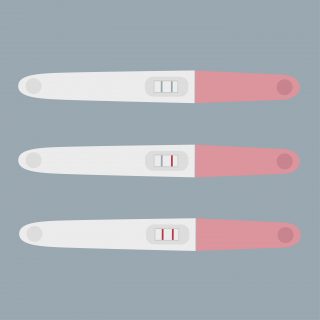
Image source: https://baby-pedia.com/
First response ovulation kit is about 99 percent accurate in determining your LH surge, and another benefit is the ease to use.
First of all, you need to get a well-concentrated urine for the test. This becomes necessary to ensure that you are getting an accurate result. In fact, to make it easy for you, it’s best you test with you early morning urine. This is because the concentration of the hormone in your “early morning uring” is still high.
Also, its possible you could miss your morning test, or you are tempted to test right away after purchasing your kit. If you find your self in this situation, its best to avoid taking water for at least 4 hours before taking your test.
The ovulation test strip is simple and comes with a control line that indicates your strip is working. Whether you are ovulating or not, if you take a test, there is a single line on the strip that acts as a control.
After collecting your urine in a container, you can dip your test-strip into the container for about 5 seconds, and then observe if you will see another line on the strip.
If there is a second line (that may seem darker than the control line), it means you have a positive result.
Can I have a false positive ovulation test result?
Like every other test out there, there is room for error. However, an ovulation kit is very accurate. Like previously mentioned, test strips from First response are about 99 percent accurate.
Also, fertility medications like Clomid can affect the accuracy of your result and for this reason, you can have a positive result. Another reason you could have a positive result is if you are already pregnant without even knowing.
To ensure that you always get an accurate result, its necessary that you understand your strip instructions, learn your menstrual cycle, and take your test one or two weeks after your period has ended.
What if I have a positive test for 2, 3, 4 days in a row?
Another issue that will get you concerned is if you have a positive result for 2, 3 or 4 days and you are worried if it is normal or not.
First of all, don’t panic unnecessarily because it is not abnormal.
When Luteinizing hormone (LH) surges before ovulation, it could last for 24 – 72 hours (that is, about 2 or 3 days): This means, if you have detected LH rise on the first day, you could see a positive result for the next few days.
When can I take a pregnancy test?
To be frank, if you have a positive ovulation result, it is surely a good sign. This is because it shows you are ovulating and you can have a baby if intercourse also happens at the right time.
But there are other factors that can decrease your chance of having a baby; And for this reason, a positive ovulation test will not always result in pregnancy.
Also, if you are still anxious and want to take a pregnancy test, its best to delay until you’ve finally missed your period. If your period doesn’t come for one or two days, it is a good sign and it could be pregnancy. So, be optimistic and take a pregnancy test after you’ve missed your period.
On the other hand, you may become so worried and may want to have a quick answer if you are pregnant or not. It’s still possible to have a quick pregnancy test even before missing your period. However, it is not recommended and the result you get will not be accurate.
Should you get a positive result though, it’s likely you will be pregnant.
