
7 Causes of Cramps before Periods

Last updated on July 28th, 2018 at 04:40 am
Are you worried about your cramps before periods? Did you notice a heavy or light spotting before period too?
Cramps before period (pre period cramps) can be a blessing or a curse. It could be an early sign of pregnancy or due to medical conditions like endometriosis or ectopic pregnancy.
While cramps are common just before menstruation starts, there are other possible causes.
What causes cramps before periods?
Cramps before your period may not mean any problem at all. Some women may experience severe menstrual cramps while others may have mild cramps before their period starts. These are the possible causes of cramping before your period
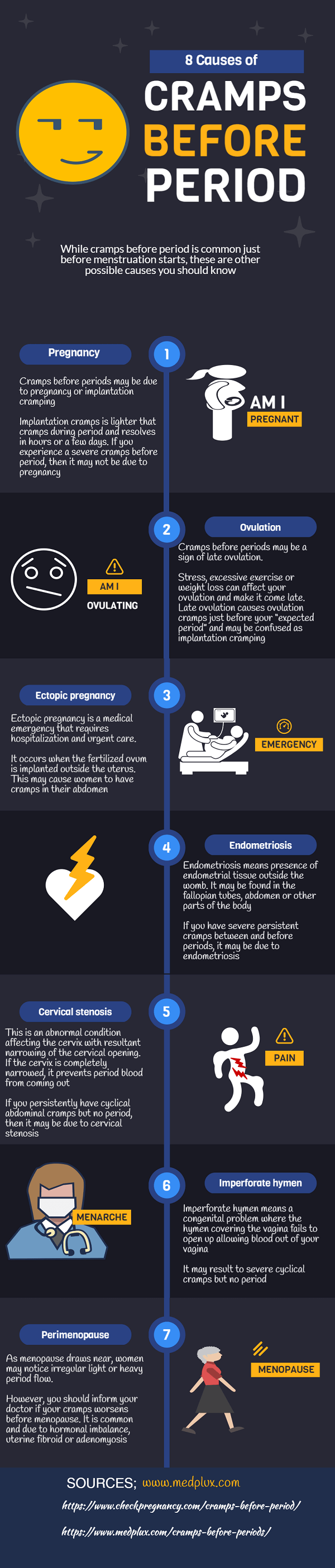
1. Pregnancy or implantation cramps
Cramps before periods may be due to pregnancy or implantation cramping.
Did you notice a light spotting early before your period?
Any sign of pregnancy — nausea, feeling tired or change of appetite?
Implantation occurs when the product of fertilization (embryo) is attached to the endometrium. During this process, some women may experience slight bleeding and cramping. This cramping is called implantation cramps.
What does implantation cramps feel like?
Cramps before period with brownish discharge may be an early sign of pregnancy. You should get a pregnancy test to confirm.
Implantation cramps are lighter that cramps during period and resolve in hours or a few days. If you experience severe cramps before period, then it may not be due to pregnancy. However, you should let your doctor know if your cramps affect your daily activities.
When should I get a pregnancy test done?
A pregnancy test may reveal if you’re pregnant or not. However, it is more accurate few days or a week after implantation cramping and bleeding. You can wait a few days and run a pregnancy test.
If still negative, you should repeat your test. There are other possible reasons why your period is late this month.
2. Ovulation
Cramps before periods may be a sign of late ovulation. Stress, excessive exercise or weight loss can affect your ovulation and make it come late. Late ovulation causes ovulation cramps just before your “expected period” and may be confused as implantation cramping.
If you experience cramps 2 weeks before your period, then it’s likely because you’re ovulating.
What is ovulation?
Every healthy woman releases one or more eggs every menstrual cycle during her reproductive years. This egg is released from the most matured ovarian follicle. This expulsion or rupture of ovarian follicle with the release of egg is termed ovulation.
How can I detect my cramps before period is due to ovulation?
- Cramping 2 weeks before your period
- Ovulation discharge which is clear watery and egg white
- You feel signs of ovulation
- You notice brown discharge 2 weeks before period
Still not sure about your ovulation sign and symptoms, then you should get an ovulation kit or fertility monitor.
Want to know your ovulation signs? Click here.
3. A sign of ectopic pregnancy
Ectopic pregnancy is a medical emergency that requires hospitalization and urgent care. It occurs when the fertilized ovum is implanted outside the uterus. This may cause women to have cramps in their abdomen.
Other symptoms of an ectopic pregnancy are abdominal pain, vaginal bleeding or bloody mucus discharge, severe pain while having intercourse and body weakness.
If you’ve had a previous ectopic, then your abdomen cramps are likely due to an ectopic pregnancy.
Other risk factors that increase your chances of having ectopic pregnancy are:
- Poorly treated vaginal infections
- Women older than 35 years
- Previous history of an abortion
What to do?
You should inform your doctor especially if you are having abdominal cramps and feeling very weak or dizzy.
4. Endometriosis
Endometriosis means the presence of endometrial tissue outside the womb. It may be found in the Fallopian tubes, abdomen or other parts of the body.
If you have severe persistent cramps between and before periods, it may be due to endometriosis. Other symptoms are
- Pain during intercourse
- Difficulty getting pregnant
- Dysmenorrhea
- Difficulty urinating
What to do?
Inform your doctor. Pain relief drugs can be used to release your cramps.
5. You are close to menopause
Are you between 40 and 50 years with cramps before periods? Then it’s likely a sign of peri-menopause.
As menopause draws near, women may notice an irregular light or heavy period flow.
However, you should inform your doctor if your cramps worsen before menopause. It is common and due to hormonal imbalance, uterine fibroid or adenomyosis.
6. Imperforate hymen
Do you have a cyclical pain and cramping without period? If you’ve never had a period for the first time, then it could be due to an imperforate hymen.
Imperforate hymen means a congenital problem where the hymen covering the vagina fails to open up and allow menstrual blood out of your vagina. It may result in severe cramps but no period.
What to do? Inform your doctor.
7. Cervical stenosis
This is an abnormal condition affecting the cervix with resultant narrowing of the cervical opening. If the cervix is completely narrowed, it prevents period blood from coming out.
If you persistently have cyclical abdominal cramps but no period, then it may be due to cervical stenosis or imperforate hymen.
7 Reasons to worry about cramps before period
- You feel severe pain or cramps between period
- You are finding difficult to conceive
- Cramps before period but no period
- Difficulty passing urine
- Pain during intercourse
- Feeling dizzy with abdominal cramps and vaginal bleeding
- Low abdomen pain and fever
FAQs about cramping before periods
These are some common question about cramps before your period. Let us know your issues below.
Is it normal to feel cramps a few days before your period?
Cramps a few days or weeks before period are normal. In women, cramps may occur before period and may not be due to any problem or pregnancy. However, implantation is a common cause of cramps few days before period.
What causes cramps 3, 4, 5, 6 days before period?
If you have cramps before period, then there is nothing to worry about. Pelvic pain before period is common and may not mean any problem if it occurs 3 to 6 days before your period.
Do you have severe pain before period?
Do you use pain killers to relieve your pains?
If you have cramps before period, it may occur some 2-3 days before period and last until 48 hours after your period starts.
Cramps before period due to pregnancy is mild and short lasting.
What do cramps a week before period mean?
While cramping before period may not be due to any medical problem, it may be due to pregnancy.
If you have cramps a week before period, then it may be implantation cramps. Did you notice any bleeding before period? Then it’s likely pregnancy.
Other causes of cramping before period
- Endometriosis
- Ovulation
- Pelvic inflammatory disease
What causes cramps 2 weeks before period?
If you have cramps 2 weeks before your period, then it is likely because you’re ovulating. Ovulation or egg release from the ovary causes women to have slight bleeding and cramping 2 weeks before period.
This belly pain is lighter and less severe than your menstrual cramps.
How many days before your period do you get cramps?
It’s normal for women to have severe pain 1 – 3 days before period starts. This pain sometimes last 1 – 2 days after period starts getting mild as your period ends.
However, cramps can occur in women anytime and may be due to ovulation, implantation, and endometriosis.
If you get cramps but no period, what’s the cause?
- Pregnancy
- Ovarian cyst
- Pelvic inflammatory disease
- Endometriosis
- Pregnancy loss or miscarriage
- Ectopic pregnancy
Now it’s your turn. Do you have cramps before periods? Are you worried about it? Let us know.

Amy charles
Hello, I had my last period on the 16/07, lasted about 4 days! I have a very regular 28 day cycle! On the 24th of July I had what could be classed as spotting and have been cramping ever since! My next period is due this Sunday 13th the latest! I have had the cramps from the 24th and need the toilet more than usual! The past few days I have noticed my breasts feel different, kind of heavy and just not comfortable and they ache! I have done 3 test to date and all negative! I have had 3 c sections previous as I have big babies and the latest one was only 7 months ago! We are ttc and have been for a few months now! You’d think I would know the difference by now but very confused! I’ve used no birth control since having my last baby!
Thanks
Amy
Dr. Dunn A.
Hi, Amy, I know how you feel and it’s very disturbing. But your symptoms suggest you may be pregnant. If your cramping before period due to pregnancy you will test negative at this time. Have some patience and see if period gets delayed for a few days. If period get delayed, you should test 7 days after. A pregnancy test is more accurate when done 7 days after missing period.
Hope this helps.
Jules
Hi I had a natural miscarriage on 8th September I was 5w bleeding had stopped and my hcg blood test was negative by the 11th September. Dr said me and my partner could try again as my health was good. Anyway we had unprotected sex the 19th and the 20th September since from the 26th I’ve had period like cramps on and off daily. I’m sure I’m now due to start my period on the 6th October