
What Causes Bleeding Or Spotting After Period Ends?
Last updated on July 28th, 2018 at 04:46 am
Are you worried that you are still bleeding after period? Are you also worried your spotting after period could be a fibroid or a medical problem? Is your spotting after period heavy?
Normal period length experienced by women is normally 2 – 7 days. If your period is less than 2 days, then your period is short. If your period is more than 7 days then its a prolonged period. Do you see large blood clots during periods? Large blood clots could also mean there is a problem.
While causes of spotting after period may be due to a medical problem or stress, it could also be due to uterus not expelling all endometrial tissues from the uterus during menstruation
This Medplux guide will explain the causes of bleeding after period and when you should worry.
Causes of bleeding after period?
If you keep bleeding after period, then these are some of the reasons you may have bleeding
1. Expelling old endometrial tissues
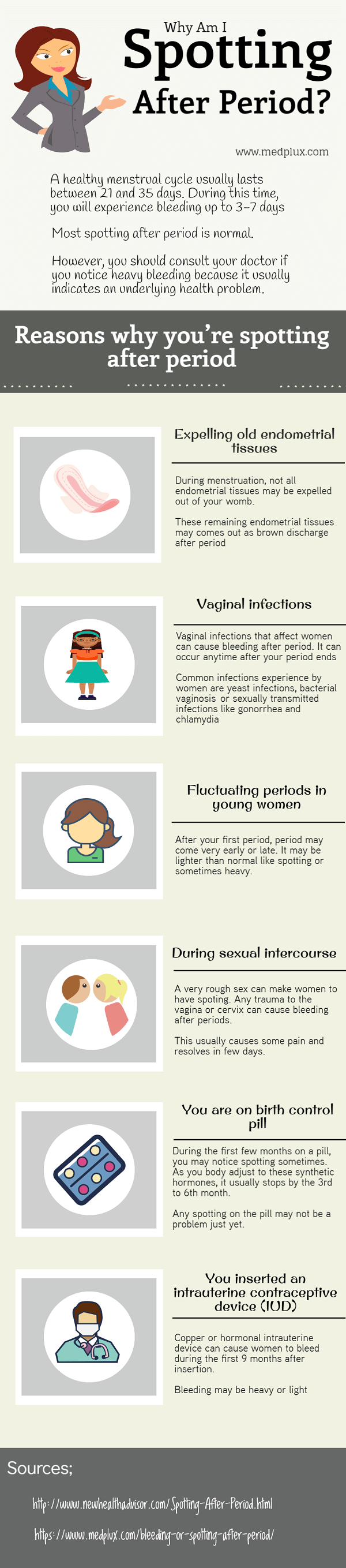
Are you still bleeding right after your period ends? Then its likely due to the removal of old endometrial tissues. During menstruation, not all endometrial tissues may be expelled out of your womb.
These remaining endometrial tissues may comes out as brown discharge after period. Are you worried it is bright red? It could also be pink discharge after period. If you are spotting after period, then this could be the cause.
However, it resolves quickly and it is lighter than your flow during period.
2. Vaginal infections
Vaginal infections that affect women can cause bleeding after period. It can occur anytime after your period ends. Common infections experienced by women are yeast infections, bacterial vaginosis or sexually transmitted infections like gonorrhea and chlamydia.
Yeast infection, which causes vaginal itching and vulva sore, is caused by Candida albicans. Women complain of cottage cheese mucus that can be uncomfortable with pain during sexual intercourse.
Bacterial vaginosis infection affects women’s vagina too. It is caused by Gardnerella vaginalis and women usually complain of fishy smelling discharge that makes them uncomfortable.
Chlamydia, trichomonas infection, and gonorrhea are sexually transmitted diseases that if left untreated may result in pelvic inflammatory disease (PID).
Symptoms of vaginal infections are
- Green mucus discharge
- Pain in the vagina
- Difficulty getting pregnant
- Ectopic pregnancy
- Pain during intercourse
- Yellow mucus discharge
If your spotting after period is due to vaginal infections, it will cause random spotting between periods. You should inform your doctor for evaluation and treatment.
3. Fluctuating periods in young women
If you’ve reached the aged girls get their period for the first time, then your periods over the next few years may be lighter or irregular. It may take up to 6 years for your hormones to normalize. You may sometimes have an early period or a late period.
If you are still notice spotting after period just after menarche, then its likely due to hormone fluctuations.
4. During intercourse
Did you notice you’re bleeding after intercourse? A very rough sexual intercourse can make women bleed after periods. Any trauma to the vagina or cervix can cause bleeding after periods. This usually causes some pain and resolves in a few days.
5. You are on a birth control pill
Are you currently taking any birth control pill? Then it may be the reason you are spotting after your period. During the first few months on a pill, you may notice spotting sometimes. As your body adjusts to these synthetic hormones, it usually stops by the 3rd to 6th month. Therefore, any spotting on the pill may not be a problem just yet.
Do you feel heavy bleeding with blood clots? Then is important to contact your healthcare provider.
6. You inserted an intrauterine contraceptive device (IUD)
If you recently inserted an IUD and you are spotting after period, then it may be the cause. Copper and hormonal IUDs can cause women to bleed during the first 9 months after insertion. Bleeding may be heavy or light. You should inform your doctor if it very heavy.
7. You have a fibroid
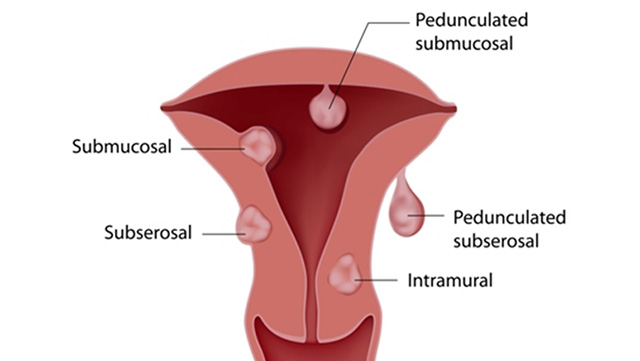 Fibroids are non-cancerous growths or mass that can be found in the abdomen. It may be small or huge with vaginal bleeding after periods.
Symptoms of a fibroid mass are
- Young woman above age 30 years
- Irregular periods
- Really long periods
- Bleeding before period
- Difficulty getting pregnant
- A very large fibroid can cause problems with passing urine and stool
8. You have a cervical polyp
The are polyps found in the cervix usually caused by high estrogen level or inflammation. If you have a cervical polyp, then these are some of the symptoms you may have
- Bleeding after period has ended
- Vaginal bleeding after sexual intercourse
- Thick white vaginal discharge
- Black period blood if there is an obstruction of the cervix outflow
9. You have a uterine polyps
A uterine polyp, which attaches to the uterine wall, can cause women to bleed after period. Other symptoms of a uterine polyp are:
- Pain during sexual intercourse
- Heavy painful periods
Uterine polyps can be removed through surgery.
10. You are ovulating
Ovulation, which is matured follicle rupture with the release of an egg, can cause women to bleed after period ends. After rupture of the Graafian follicle (Matured follicle), it may cause bleeding. This bleeding usually occurs a week after your period ends or in between 2 of your periods.
If you are spotting a week after period ends, then its likely due to ovulation. You should learn when women ovulate and signs of ovulation to easily know when ovulation occurs.
11. You are pregnant
Pregnancy which is usually achieved if the sperm fertilizes the ovum may cause you to bleed after period. This bleeding is as a result of implantation which occurs before your next period.
If you are bleeding about 14 days after period ends, then its likely due to pregnancy or implantation.
9 Reasons to worry about spotting after period
- You experience smelly vaginal discharge (This is a sign of infection)
- Your vagina is itching and there is sore down there
- You are taking aspirin. This drug prevents clotting resulting in increased bleeding.
- Your period is now lasting longer than 7 days
- You continue to have bleeding after sexual intercourse
- You are getting weak from increased bleeding after period
- Your period has thick blood clots
- You feel pain in your lower abdomen
- Your abdomen is swelling with vaginal bleeding
Steps to take if you are spotting after period
- Inform your doctor
- Get a menstrual cup if you are bleeding heavily
- Consider stopping aspirin
- Regular exercise
- Treat your vaginal infections
- Surgery to remove your fibroid mass and polyps
- Are you more than 40 years? Get an endometrial biopsy done to rule out any form of cancer
- Reduce your stress level
- Regularly do a pap smear to rule out cervical cancer
FAQs about vaginal bleeding after periods
These are some asked questions about bleeding after period? Your question not yet answered? Let us know below.
What causes bleeding or spotting after period ends?
If you are spotting after period ends then its likely due to the removal of old tissues in your womb that were not removed during your last period. It usually comes out as brown mucus discharge after period. Other causes are
- Uterine fibroids
- Sexual intercourse
- Cervical or uterine polyps
- Vaginal infections
- Ovulation
What to do? If you experience bloody discharge after period then it may resolve in a few days if due to old endometrial tissues. If it is persistent, you should let your doctor know.
Brown spotting after period, What causes it?
If you have brown spotting after period, then it simply means your blood mixed with white vaginal discharge. It can be due to
- Old endometrial tissue removal
- uterine fibroid
- Birth control pill
- Vaginal infections
- Pelvic inflammatory disease
What causes light bleeding after period
If you notice a light bleeding after your period, it is due to
- Removal of old tissues not expelled during menstruation
- Uterine fibroids
- Pelvic inflammatory disease
- Birth control pills ( Breakthrough bleeding)
Light bleeding after period may be a sign of miscarriage. Did you have an early period that was light with cramps? Do you currently feel the signs of pregnancy? Not sure about your symptoms, you should inform your doctor.
I’m still bleeding after period ends, why?
If you are still bleeding after period ends then your period is prolonged. Normal period last between 2 and 7 days. If your period continues over a week or 7 days then you should let your doctor know.
Common causes are
- Uterine fibroid
- Stress
- Polycystic ovaries
- Maybe miscarriage
- cervical polyps
- Endometrial cancer
What causes bleeding one week after period?
If you are bleeding about one week after your period ends then it is likely because you’re ovulating. Ovulation bleeding or spotting occurs due to the rupture of the most matured follicle. This bleeding usually last for a few days with some cramps.
What causes heavy bleeding after period?
If you had an unusually heavy bleeding after period, then its likely due to a medical problem. Heavy bleeding after period may be due to any of these
- Fibroids
- Endometrial cancer
- Endometrial hyperplasia
- Inserted IUDs
- Uterine polyps
- Polycystic ovaries
Now it is your turn. Do you have spotting after period ends? Let us know.

Jls
I have a very regular 26 day cycle bleed heavy for 4 days and then it’s over, has been for years. I’m now on cd 8, I bled as usual heavily from cd1-4 cd5 till now (ongoing) I’ve had a small amount of very bright red/pink blood every time I wipe (as if af has just arrived sort of amount) this is really abnormal for my cycle. I’ve been having cramps mainly on my right side and lower abdomen, felt nauseous, exhausted, need the loo more often and have had headaches but a negative pregnancy test ruled out all of that. Any ideas would be greatly appreciated!!
Tina
Hi jls did your problem ever resolve itself ?
Sadi zahi
My age is 25 and i am facing a problem from 2 or 3 years even when i was single.3 or 7 days after my periods dark brown or redish brown blood clots comes out with right side pain and sometimes back pain.my dr recomend me altrasound which is fine. Now its been 6 months i am married and not conceiving please tell me any solution.